
All search inputs within The Social History Archive platform fall into two main pathways: the keywords field (for general text search, phrase syntax, exclusions, and prioritisation) and the names field (specifically tuned for historical personal name variations).
Names
The names field in the search form is designed specifically to handle searching for mentions of people by name in the archive. It is totally optional – if you are not searching for names, then only use the keywords field. However, if you are searching for articles which reference individuals by name, then this search box is an effective tool.
Names in newspapers can occur in a range of formats. So for example, ‘James Robert Wilson’ may appear as:
| James Robert Wilson | Wilson, James Robert | Mr James Wilson |
| James Wilson | Wilson, James R. | Mr James R. Wilson |
| James R. Wilson | Wilson, James | Mr Wilson, James |
| Mr & Mrs James Wilson | etc. |
The names field will take the input ‘James Robert Wilson’ and return matches against all of these. It will also perform the same combination of logic on multiple names (separated by commas).
So a search for ‘James Quinn, William Lavery’ will yield:
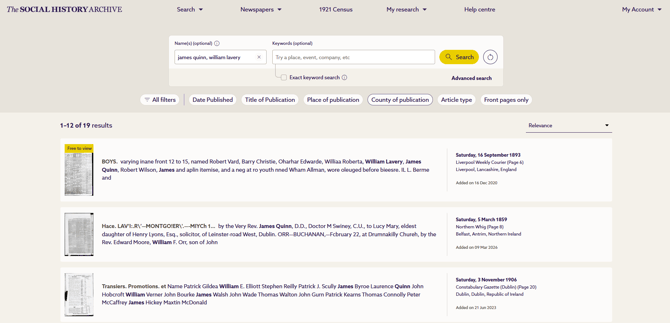
The search on multiple names works as a ‘must include’ – so results must include a reference to every name mentioned.
A single name (e.g. Wilson, or James) in the name field won’t yield any useful results versus using the keyword field – the names field is designed to function on the input of names with at least two words.
Name search is essentially based on handling each name as a phrase with a phrase flex of 2 (and exact words on) – so wildcards won’t work.
There is separate processing to handle middle names (including initials), and titles, honorifics, and military ranks. This will run searches both with and without these terms, prioritising results which match the ‘richest’ form of the name.
The result relevance is heavily weighted towards matching text in the body of an article, rather than in the title – which is the opposite of the weighting in the keywords field.
In time, as more accurate name extraction and processing becomes available, the sophistication of this name-matching capability will continue to develop and improve.
What not to do in the name field
Searches will still yield results – but they will not be consistent or accurate with regards to the handling in the keywords field.
-
Don’t enter words other than the names of individual people.
-
Don’t add multiple variants of the same name – the search will treat multiple names as ‘must include all’.
-
Don’t use any of the search syntax symbols (-, #, “”,~3) – they will be ignored.
-
Don’t use wildcards – they won’t work.